Most fatal accidents in light aviation don’t start with a broken aircraft. They start with one person, in one seat, running out of attention at the wrong moment. Here is what an AI copilot can do about it.
Airlines solved their safety problem decades ago. Two pilots, strict procedures, and automation that watches the aircraft while the humans watch each other. The result is the safest form of transport in history.
General aviation never got that luxury. A single pilot in a light aircraft is navigator, radio operator, flight engineer, meteorologist and decision-maker at the same time, often with no second crew member and nobody to say “hey, did you see that?”
The accident statistics show exactly where this breaks.
Where general aviation still loses lives
AOPA’s Air Safety Institute has published its accident report, for decades known as the Joseph T. Nall Report and today as the Richard G. McSpadden Report, for more than thirty years. Edition after edition, the conclusion is the same: roughly seven out of ten accidents in non-commercial fixed-wing flying are “pilot-related”. Not the engine, not the weather as such, but loss of control, continued VFR flight into instrument conditions, controlled flight into terrain, and the decisions that led there.
Europe looks the same. EASA’s Annual Safety Review 2025 counted 27 fatal accidents and 44 fatalities in general aviation with non-complex aeroplanes in 2024, and the risk areas it keeps highlighting for this segment, year after year, are aircraft upset (loss of control), terrain collision and mid-air collision. Figures for 2025 published by EASA and Eurostat add a sobering detail: of the 116 people who died in aviation accidents in the EU or on EU-registered aircraft that year, 109 were on private, non-commercial flights.
Behind those numbers are a handful of scenarios every pilot has heard about since ground school:
- Weather. Continued VFR flight into IMC is a small share of all accidents but the most lethal category there is: more than 75 percent end in a fatality. The classic study behind the “178 seconds” figure found that a pilot who loses the horizon without instrument skills loses control of the aircraft in about three minutes.
- Terrain. Controlled flight into terrain remains among the top fatal categories: a perfectly healthy aircraft flown into a hill, in cloud, at night, or in a valley the pilot thought was wider.
- Traffic. Mid-air collisions are rare, but EASA consistently lists them among the highest risk areas for GA, and “see and avoid” has well-documented limits: a converging aircraft sits almost still in the windscreen until the last seconds.
- Engine and systems. Mechanical and maintenance issues account for roughly one accident in six, and many of them announce themselves minutes earlier as a slowly rising oil temperature or a falling pressure that nobody was watching.
- Radio. A misheard altitude, a missed clearance, a wrong read-back. Rarely fatal on their own, but they are the raw ingredients of airspace busts, runway incursions and near misses.
What these have in common is not a lack of knowledge. Every pilot knows what VFR into IMC means. The problem is attention and workload: one brain, five things to watch, and the dangerous moment always arriving when that brain is busiest.
What a second pair of eyes changes
This is exactly the problem a second crew member solves in an airliner, and exactly where an AI copilot earns its place in a light aircraft. Not to fly the aircraft. To watch what the pilot can’t watch right now, and say it out loud.
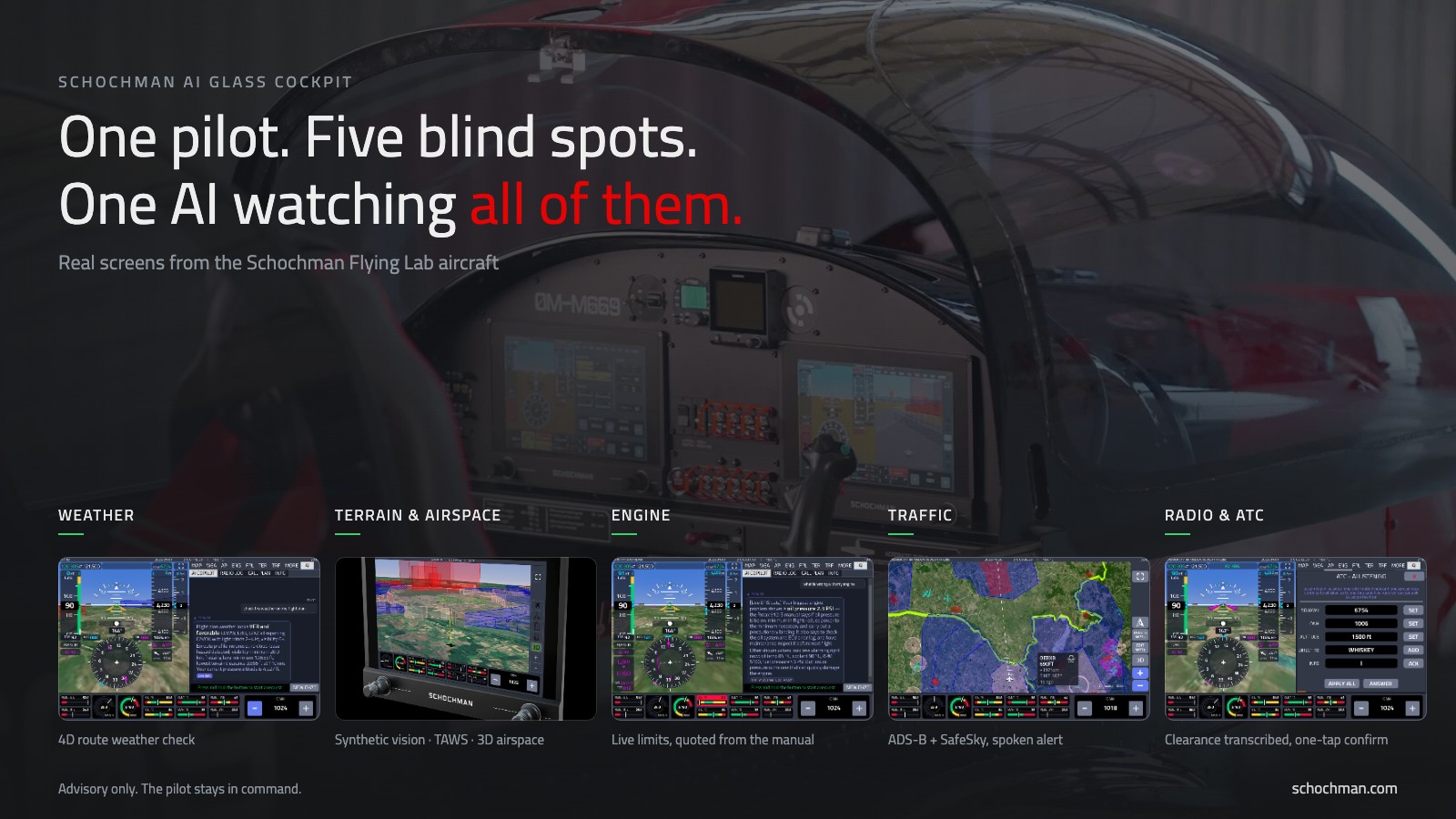
Here is how it works in the Schochman AI Glass Cockpit, blind spot by blind spot, with real screens from our Flying Lab aircraft.
1. Weather: the go/no-go call, checked in four dimensions
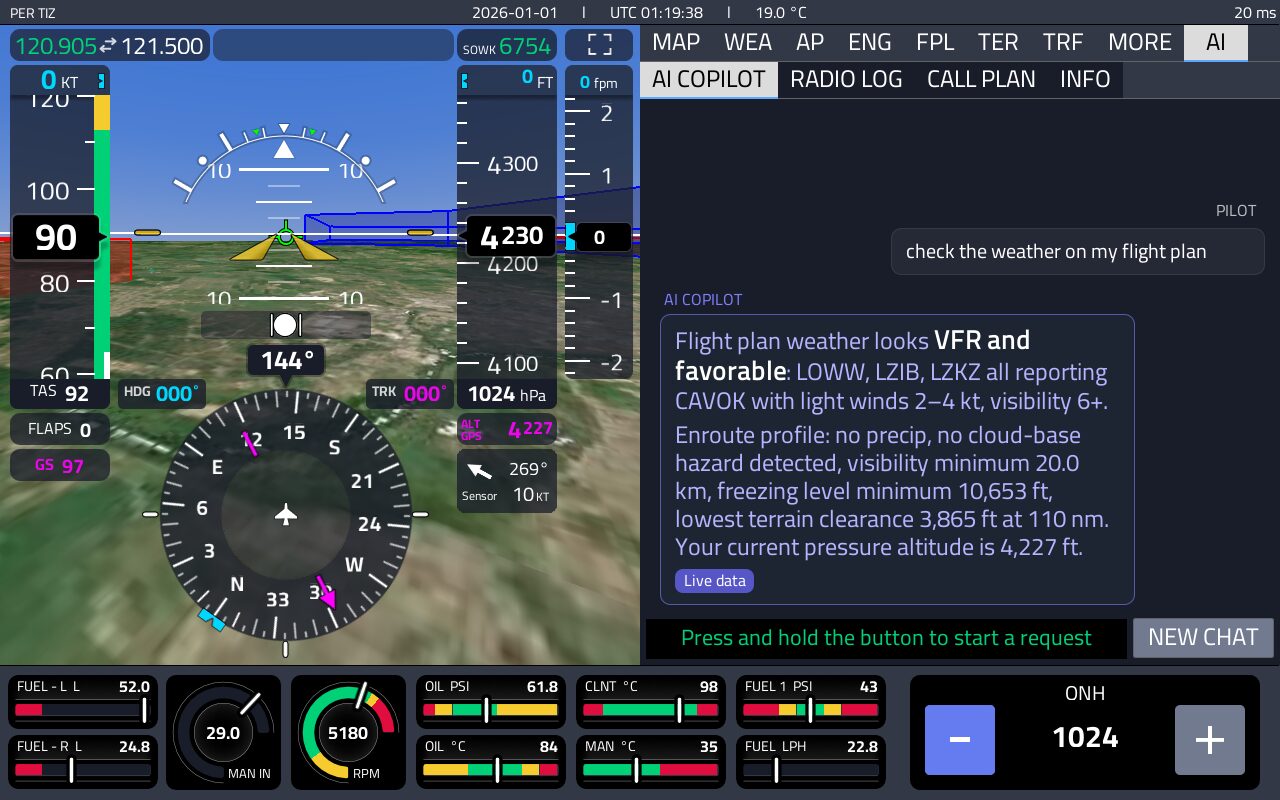
A standard briefing is a METAR here, a TAF there, and a radar picture that is already twenty minutes old. The pilot stitches it together in their head and hopes the gaps are harmless.
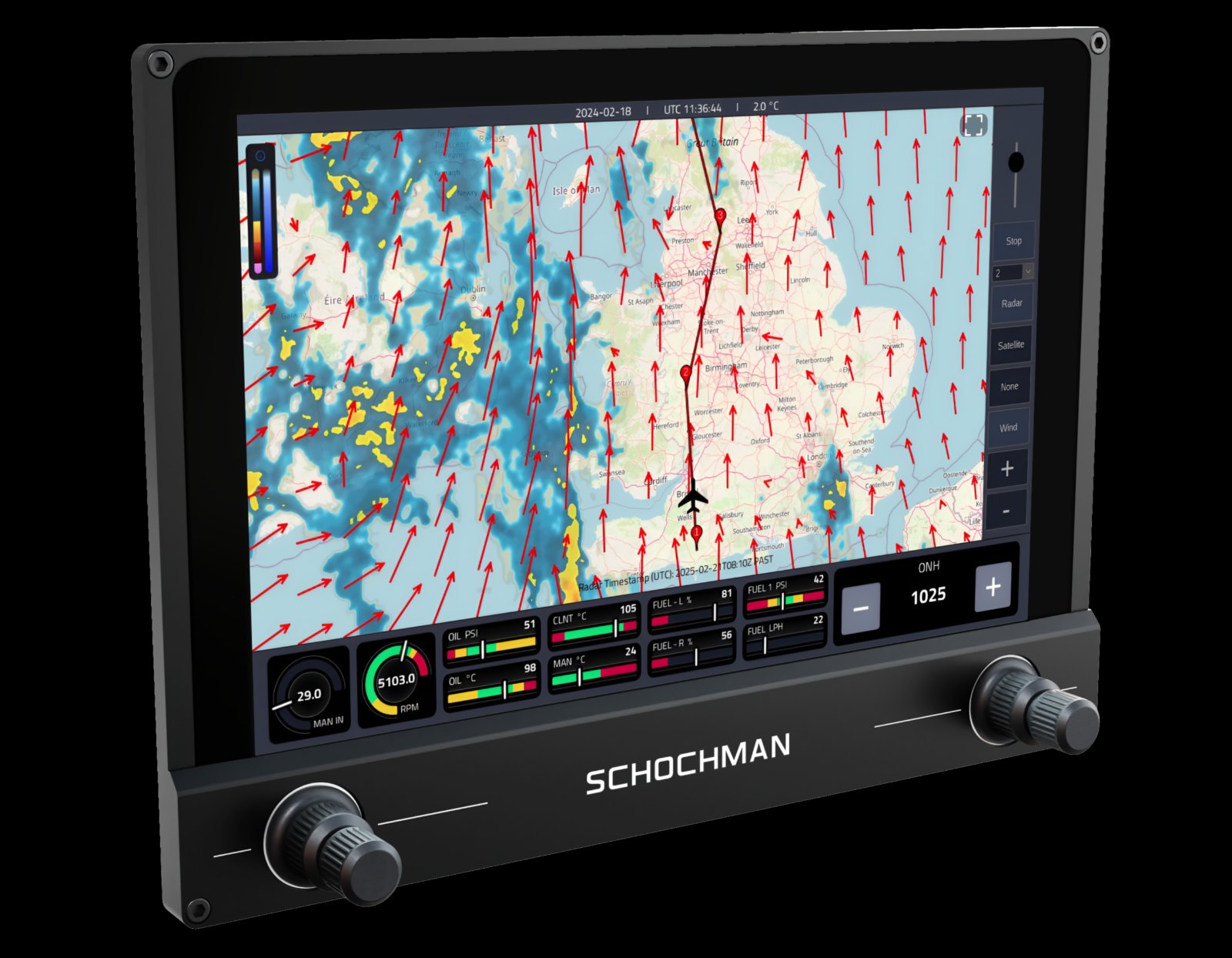
The Schochman weather agent does the stitching for you. It reads METARs, TAFs and thousands of sample points along the planned route, not just in x and y but at altitude and in time, because the weather that matters is the weather at your cruising level when you actually get there. The result is a plain-language answer: conditions at each waypoint, freezing level, lowest terrain clearance, and the one thing you want to know before engine start: should this flight go at all?
Once airborne, real-time weather radar and wind vectors stay on the panel, along the route, with no tablet involved.
2. Terrain and airspace: seeing the hill before it sees you
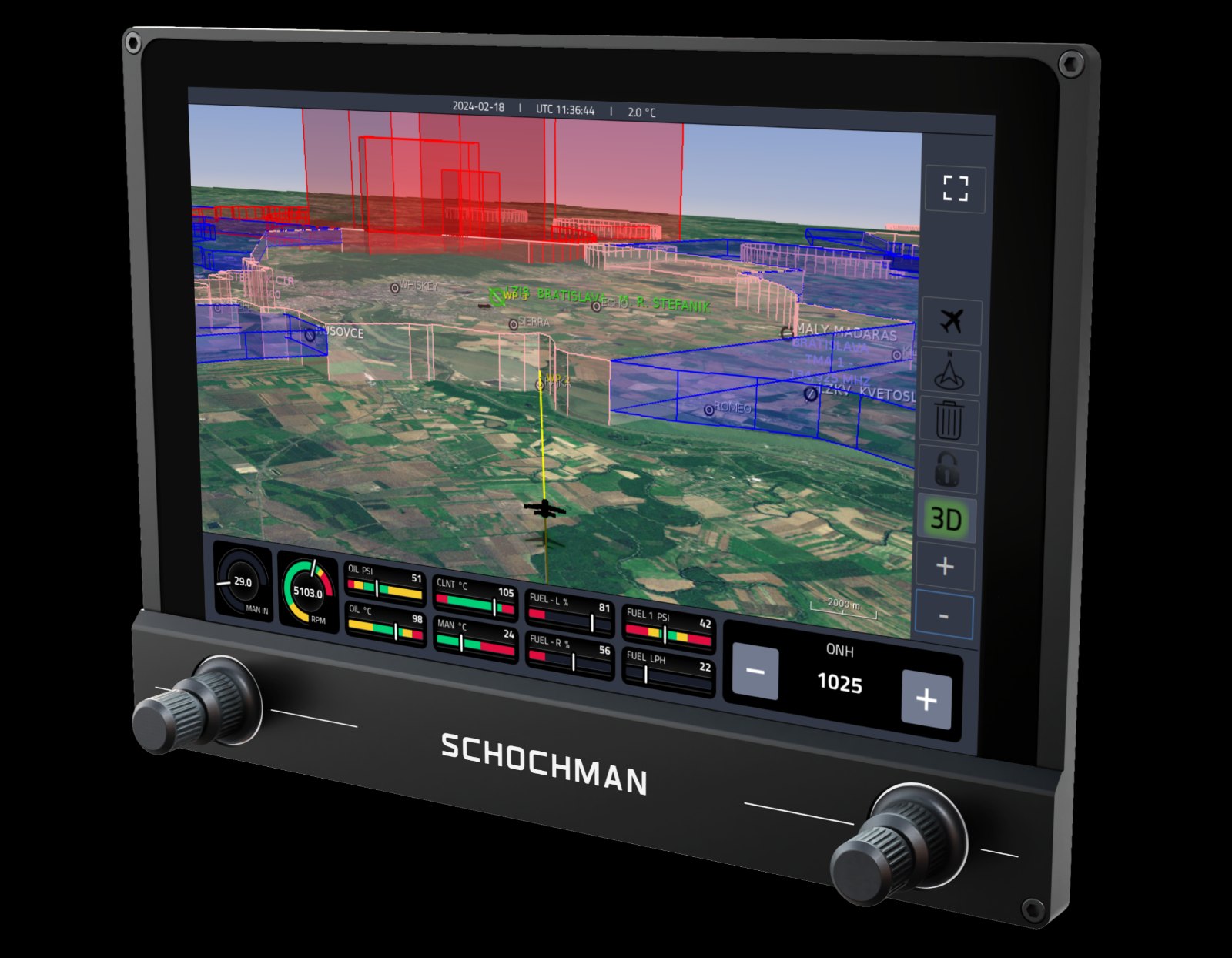
Synthetic vision draws the terrain ahead exactly as it would look on a clear day, even when it isn’t a clear day. Terrain awareness (TAWS) colours the ground that is getting too close, and 3D airspace shows controlled zones as volumes you fly around, not as lines on a chart you can misread.
The point isn’t the graphics. A CFIT accident requires a pilot to be surprised by terrain. A screen that shows the ridge in front of you at the exact moment you lose the horizon takes most of the surprise out of it.

3. Engine: the failure that announced itself ten minutes earlier
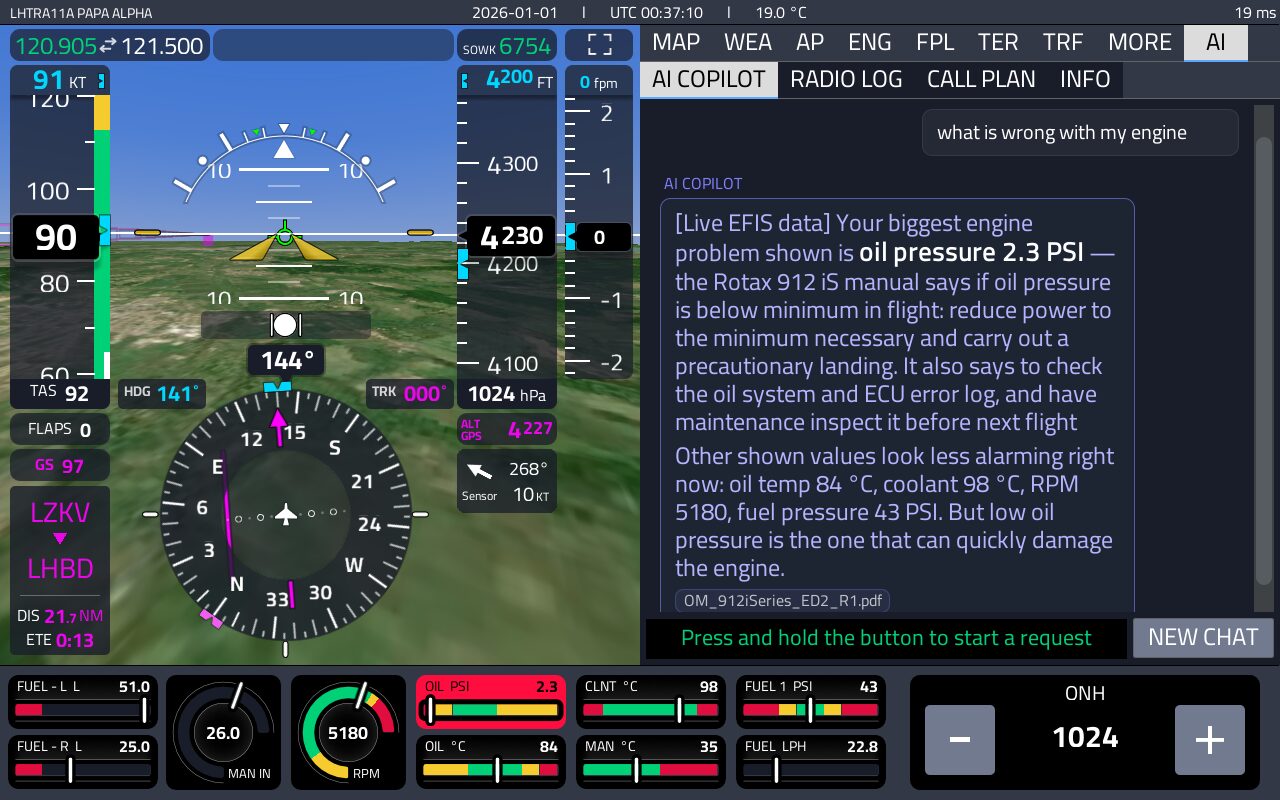
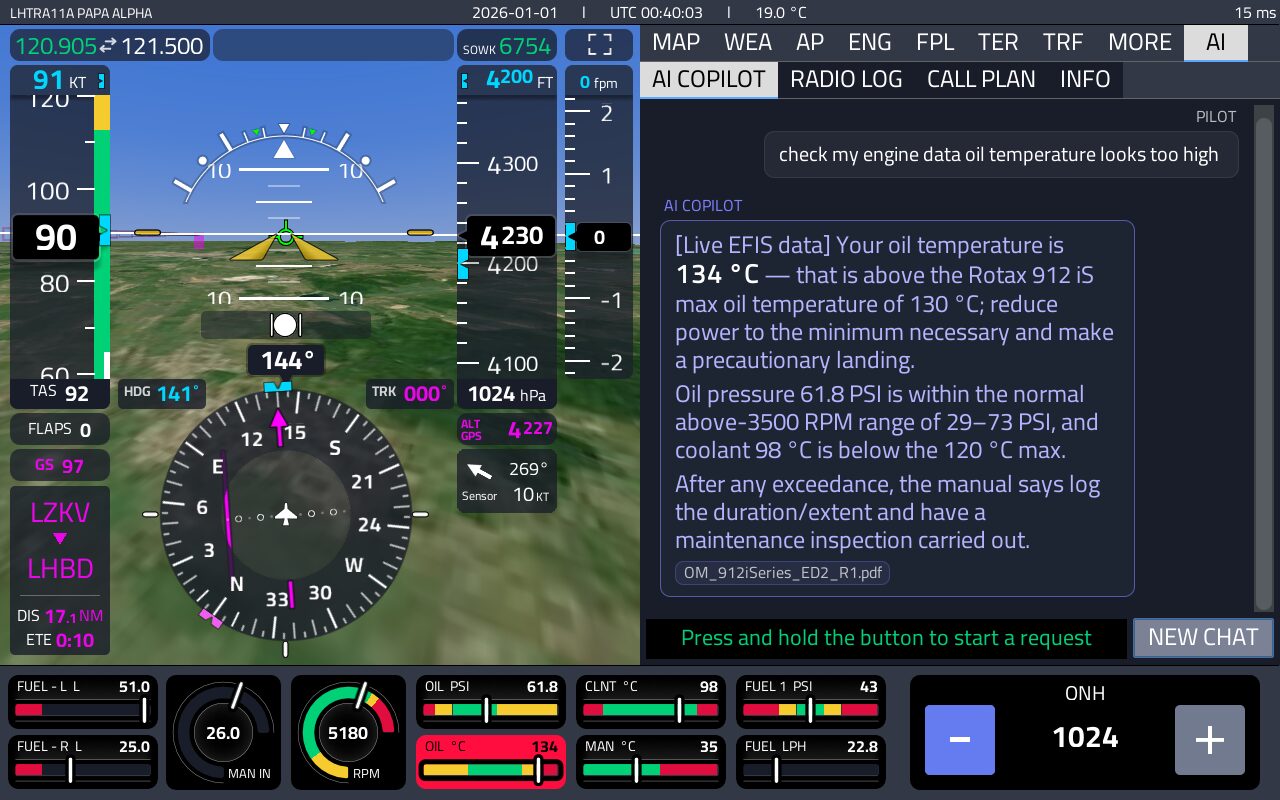
Most engine problems in a light aircraft don’t happen suddenly. They trend. Oil temperature creeps up. Oil pressure drifts down. Coolant goes over the limit while the pilot is busy talking to ATC.
The AI Copilot reads the live engine data from the EFIS continuously and compares it with the engine manufacturer’s limits. When something is off, it doesn’t just paint a number yellow. It tells you what is wrong, quotes the relevant limit from the manual, and suggests what to do: reduce power, land as a precaution, keep watching. The screens below are not mock-ups; they are what our Flying Lab pilots saw.
4. Traffic: everything that’s out there, said out loud
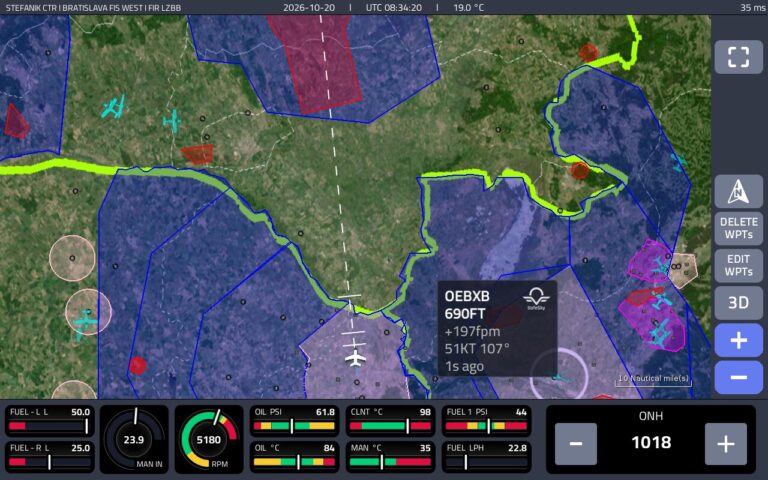
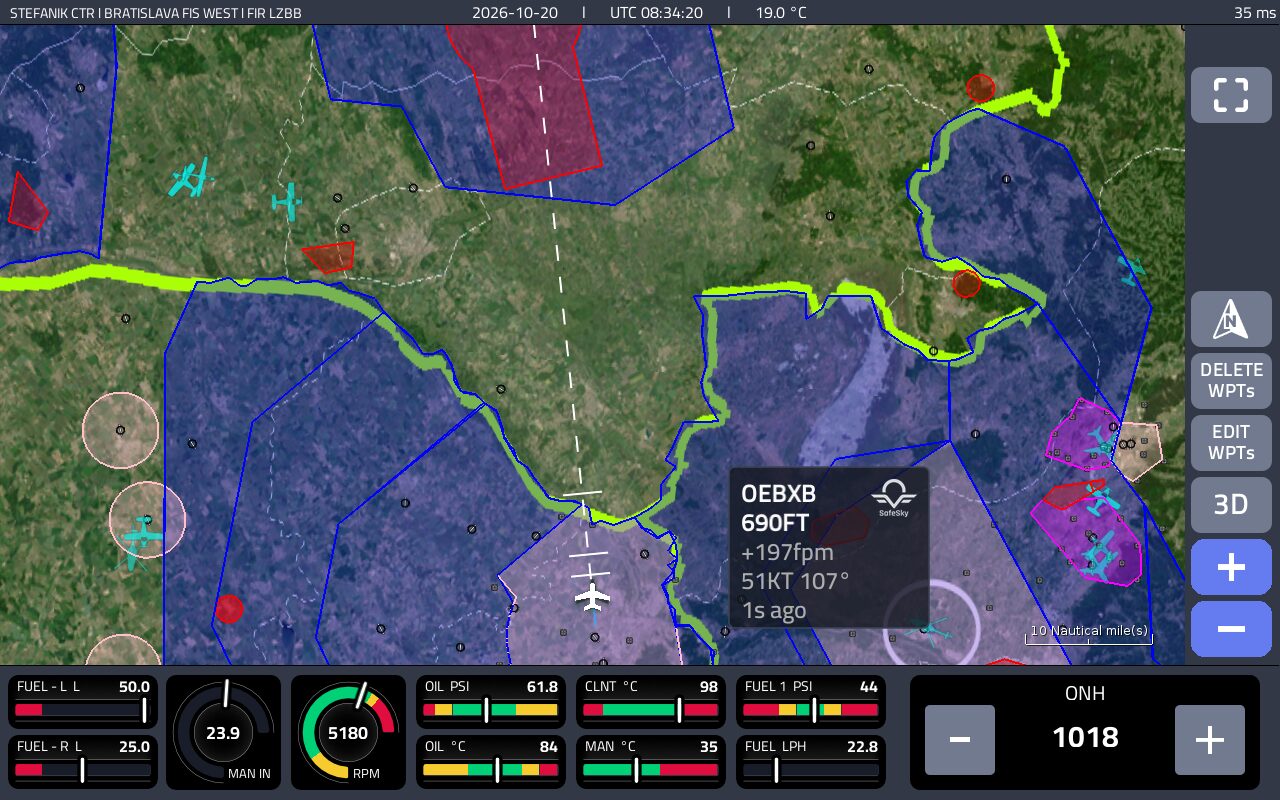
The cockpit’s own ADS-B receiver sees transponder-equipped aircraft. Fused with the SafeSky network, it also sees gliders, microlights, paragliders and drones on FLARM, OGN and other networks, the traffic a conventional ADS-B receiver is blind to.
When another aircraft comes within the alert distance, the cockpit says “TRAFFIC”, points to it on the compass and shows where it will be in 60 seconds, on any page, even if you are looking at the engine or the map at that moment. Because a mid-air collision is not something you avoid by staring at a screen harder. You avoid it by looking out of the window in the right direction at the right second, and that is what the spoken alert is for.
5. Radio and ATC: never miss the clearance
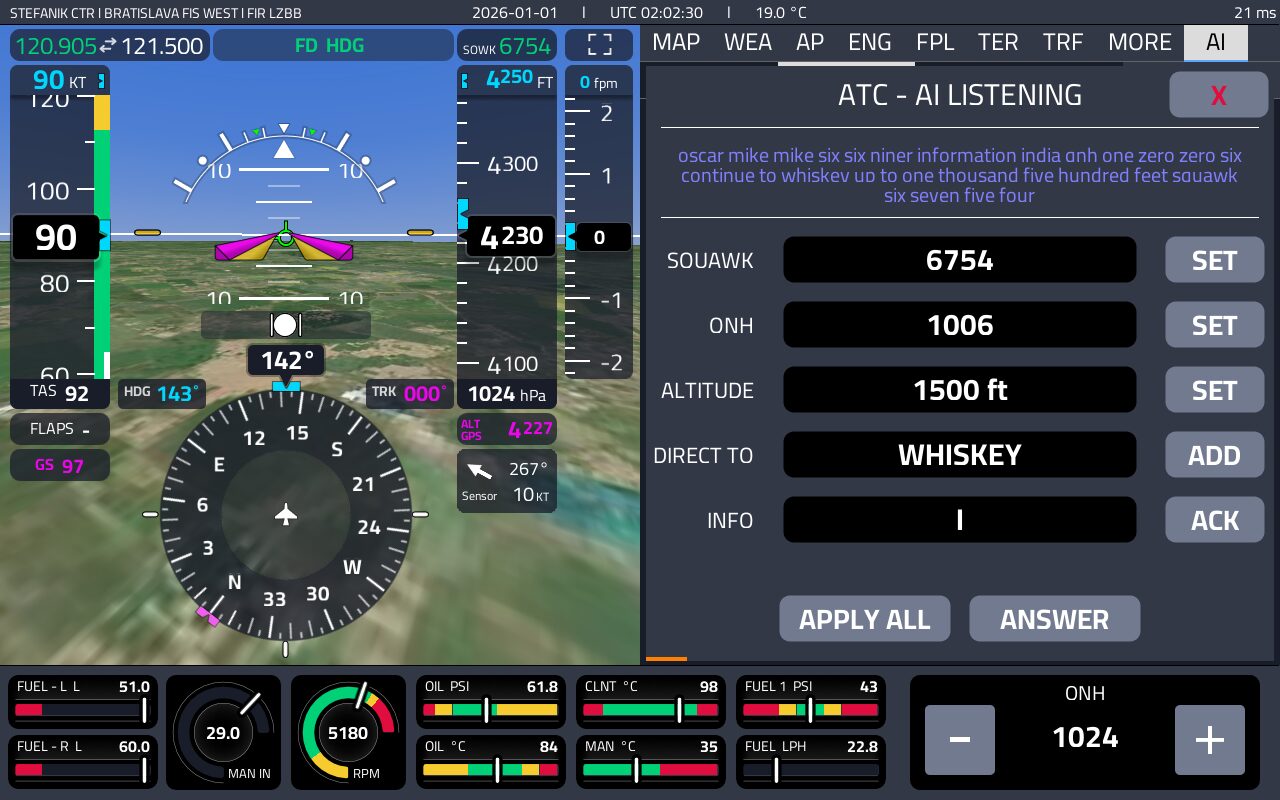
Single-pilot radio work is where workload spikes: copy the clearance, read it back, dial the squawk, set the altitude, all while flying the aircraft. The ATC assistant listens to the radio with you, transcribes the clearance and pre-fills the squawk, QNH, altitude and direct-to so that one touch confirms it. Nothing changes until you tap.
And voice control, built to cope with turbulence and accents, means the hands stay on the stick and the eyes stay outside while you ask for the next frequency or a weather update.
Where the human stays in command
We want to be precise about what this is and isn’t.
- The AI is advisory. It never changes an autopilot or system setting on its own. Every action waits for the pilot’s confirmation on the panel.
- It is not a certified TCAS or TAWS, and it does not replace training, personal minimums or a proper lookout. Traffic and terrain information depends on data coverage, radio reception and installation.
- Connectivity. In the current version the AI Copilot and the ATC assistant need a data connection. The rest of the cockpit, including synthetic vision, 3D airspace, the weather display, engine monitoring and ADS-B traffic, works without one. A lighter onboard AI that runs fully offline is planned.
- Automation can breed complacency. That is why everything is designed to pull attention outside the aircraft, not into the screen: spoken alerts, one-tap confirmations, and answers in plain language instead of another page of numbers.
Why it matters now
Airline-level safety was never about better pilots. It was about redundancy: a second set of eyes, procedures, and systems that keep watching while people are busy. For decades, that redundancy was simply unaffordable in a 600-kilogram aircraft.
An AI copilot running on a small computer behind the panel changes the economics. It doesn’t get tired, it doesn’t get distracted by the radio, and it watches the oil temperature during the one minute a human never would.
It won’t make general aviation as safe as an airline. But every scenario above, the weather trap, the hill in the cloud, the glider in the thermal, the engine that gave a ten-minute warning, is a scenario where one timely sentence spoken in the cockpit can turn a statistic into a story told at the airfield bar.
That is what we build.
👉 Meet the AI Copilot →
👉 Explore every feature →
👉 Configure your Schochman glass cockpit →
👉 Book a demo flight →
Sources: AOPA Air Safety Institute, Joseph T. Nall Report / Richard G. McSpadden Report (pilot-related share of accidents, mechanical share, VFR into IMC lethality) and the ASI Safety Spotlight “VFR into IMC”; EASA Annual Safety Review 2024 and 2025 (2024 data: 27 fatal GA accidents, 44 fatalities, key risk areas); EASA/Eurostat air safety figures for 2025 (116 fatalities, 109 on private non-commercial flights, as reported by AeroTime). Figures are rounded; see the original reports for definitions and methodology.
All assistance described here is advisory only. The Schochman AI Glass Cockpit is not a certified TCAS or TAWS and does not command avoidance manoeuvres or change aircraft settings without pilot confirmation. Always maintain visual lookout, respect your personal minimums and follow ATC and radio procedures. Schochman Aviation (Trainshot s.r.o.) develops AI-assisted avionics for LSA and GA aircraft in Slovakia. schochman.com