You’re climbing through 4,500 feet, managing your airspeed, scanning for traffic, and keeping an eye on a building cloud to the southwest. Then the radio crackles. ATC rattles off a clearance — a heading change, a new altitude, maybe a frequency handoff — and just like that, three things happened at once. Did you catch all of it? ATC clearance mistakes pilots make in moments exactly like this one are more common than the aviation community likes to admit.
If you’ve ever had to sheepishly ask for a readback because you only caught half the transmission, you’re not alone. These missed or misinterpreted clearances are among the most common — and quietly dangerous — challenges in general aviation. The cause isn’t skill or experience. Flying a single-pilot aircraft demands more cognitive bandwidth than the human brain can reliably sustain, and something has to give. The good news? Technology is starting to close that gap in meaningful ways.
Why ATC Clearance Mistakes Happen More Often Than Pilots Admit
There’s a reason ATC communication errors rarely make it into hangar talk. Nobody likes admitting they missed a transmission. But researchers have been quietly documenting how widespread the problem is. A study published in Safety Science (Molesworth, 2015) found that communication accuracy drops significantly when a radio transmission contains four or more pieces of information — a common occurrence in real ATC clearances. A 2022 study in the International Journal of Aerospace Psychology (Thorpe, Estival, Molesworth & Eidels) analysing transmissions from four major international airports reinforced this, confirming that longer messages consistently increased the number of pilot communication errors.
An FAA technical report on ATC message complexity echoes the same finding. A U.S. Department of Defense analysis of 386 Aviation Safety Reporting System (ASRS) reports also found readback errors occurring at close to one per hour on a single ATC frequency across various control environments (Prinzo, 1998). That’s not a rare slip — it’s a routine feature of how pilots and controllers interact.
The problem isn’t unique to student pilots, either. Experienced aviators miss clearances too, especially during high-workload phases like departures, approaches, or airspace transitions.
So what’s actually going wrong?
The Cognitive Load Problem
Flying demands divided attention. At any given moment, you might be cross-checking instruments, navigating around weather, managing fuel, and monitoring two frequencies simultaneously. The human brain has limits. A 2025 study published in Frontiers in Robotics and AI monitored EEG data from 22 pilots in real VFR flight conditions and found that shifts in mental workload directly alter auditory attention — the very faculty pilots depend on to process ATC communications — leading to increased error rates. This is one of the core reasons ATC clearance mistakes happen even among experienced aviators. ATC communications are particularly unforgiving in that environment.
Transmissions come fast. Callsigns blur together, especially at busy Class C or D airports. Frequencies carry background noise, stepped-on transmissions, and controllers who speak at the pace of someone who does this 200 times a day. For the pilot, it’s a firehose.
Read-Backs Don’t Always Catch the Problem
The standard fix for missed clearances is the readback — you repeat the instruction back to the controller. But readbacks have a known weakness: pilots sometimes read back what they thought they heard rather than what was actually said. When the original misunderstanding is baked into your readback, it doesn’t get corrected. The controller assumes you’ve got it. You assume you’ve got it. The clearance goes unverified.
This is sometimes called the “hearback” problem, and it’s more common than most pilots realize. According to SKYbrary, EUROCONTROL’s open-access aviation safety knowledge base, an uncorrected erroneous readback may go undetected until the controller observes a deviation on their situational display — by which point separation may already be compromised.
Radio Calls During the Wrong Moment
Timing compounds everything. A clearance that arrives right as you’re hitting a bump, scanning for traffic, or mentally re-running your approach checklist is a clearance that’s more likely to get garbled. There’s no pause button on ATC. The transmission arrives when it arrives, whether you’re ready or not.
The Real Consequences of ATC Clearance Mistakes
Most ATC clearance mistakes end uneventfully — a quick correction, a “say again,” and you’re back on track. But not always.
Runway incursions, altitude deviations, and airspace violations have all been traced back to clearance miscommunication — a pattern well documented by the FAA’s Runway Safety program, which identifies communication errors between pilots and controllers as top contributors to runway safety incidents. In the worst cases, the consequences are catastrophic. Even in minor cases, a clearance deviation triggers additional controller workload, potential TCAS alerts for nearby aircraft, and a paperwork trail you’d rather not have.
For flight schools and new pilots, the stakes are even higher. Students are still building their radio skills alongside everything else. A confusing or fast-paced ATC environment can push them past their cognitive limits quickly.
How Technology Is Changing the Way Pilots Handle ATC Communication
The aviation industry has long known about the ATC communication problem. Solutions have been slow to arrive for general aviation — partly because the market is fragmented, partly because certification processes are complex, and partly because the technology to genuinely solve the problem at an affordable price point just wasn’t there yet. A 2023 paper in the International Journal of Entrepreneurship and Management Inquiries (Kaya & Ateş) noted that only 61% of verbal aviation communication is fully understood, and specifically highlighted AI-based communication tools as the most promising emerging category for reducing miscommunication-related accidents.
That’s changing.
Real-Time ATC Transcription
One of the most practical advances to come out of AI-assisted avionics is real-time transcription of ATC communications. Rather than relying entirely on your ears and short-term memory, imagine having every transmission appear as readable text on your primary display — within seconds of it being spoken. The result is a second channel of confirmation. If you catch most of a clearance but miss the squawk code at the end, a glance at the screen fills the gap. No “say again.” No embarrassment. No doubt.
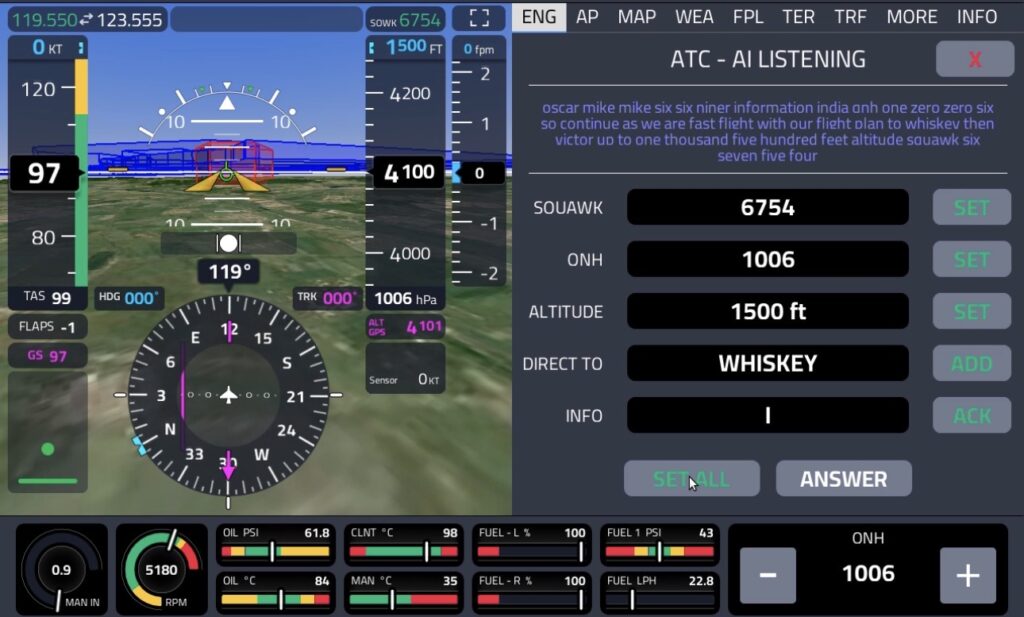
The Schochman AI Glass Cockpit takes this further: its AI stack doesn’t just transcribe — it actively listens to ATC communications, extracts structured instructions from the audio, and presents them for pilot confirmation with a single tap. The system understands the difference between a frequency change and an altitude assignment, and formats each accordingly. It’s the difference between raw text and genuinely actionable information.
Structured Instruction Extraction
Transcription is useful. But structured extraction is where things get genuinely transformative.
Instead of a wall of text, the system identifies the specific components of a clearance — heading, altitude, frequency, transponder code — and presents them in a format that’s fast to scan and easy to confirm. You’re not re-parsing radio language under pressure. You’re reviewing structured data and tapping to acknowledge.
This dramatically reduces the chance of a partial clearance being acted on as though it were complete. And it creates a natural moment of intentional confirmation rather than an assumed understanding.
How Pilots Can Avoid the “I Think I Heard” Mistake
When an AI system flags the structured components of a clearance for pilot review, it introduces a friction point that’s actually helpful. You can’t just assume you caught it correctly — there’s an explicit confirmation step. That small friction is exactly the kind of safety layer that single-pilot operations need most. In an environment where there’s no co-pilot to catch what you missed, a system that requires active confirmation rather than assumed understanding changes the dynamic in a meaningful way.
What Good ATC Communication Looks Like — With and Without Assistance
To illustrate the difference, consider a common scenario: transitioning Class D airspace on a cross-country flight.
Without assistance: ATC clears you through their airspace with a squawk code, an altitude restriction, and a frequency change — all in one transmission. You catch the squawk, get most of the altitude, and miss the new frequency entirely. You switch to what you think you heard. Silence. You realize after 30 seconds that you’re on the wrong frequency. Minor panic, rapid correction.
With AI-assisted transcription and extraction: The same transmission arrives. The system transcribes it, extracts the three components — squawk 4521, maintain 3,500, contact Approach on 124.6 — and displays them in structured form. You tap to confirm. You dial in 124.6. Clean handoff.
Neither scenario involves a safety crisis. But one involves guesswork; the other involves certainty. Multiply that difference across an entire flight — across hundreds of flights — and the risk reduction is meaningful.
Practical Tips to Reduce ATC Clearance Mistakes Today
Technology helps, but good habits matter too. Here are a few approaches that experienced pilots use to reduce clearance errors regardless of what’s on their panel:
- Write it down. Old habit, still good. A kneeboard, sticky note, or scratchpad gives you a reference when memory fails.
- Slow down the readback. Controllers appreciate deliberate readbacks. Speaking the clearance back slowly gives you time to notice if something doesn’t add up.
- Ask early, not late. If you didn’t catch a transmission, ask immediately. The longer you wait, the more assumptions you’ll have already acted on.
- Brief yourself before transitions. Anticipate what kind of clearance is likely before entering a new airspace. The brain processes expected information faster.
- Use your co-pilot. Flying with another rated pilot? Divide the radio and navigation tasks explicitly. Even a non-pilot passenger can help by watching the screen on a system that displays transcribed clearances.
- Let technology back you up. AI-assisted avionics that transcribe and structure ATC clearances in real time are entering the general aviation market, with onboard systems now available for light aircraft. Used alongside good radio habits, they add a reliable second layer of confirmation — particularly useful during high-workload phases when your attention is already stretched thin.
The Bigger Picture: Reducing Pilot Error Through Better Information
Pilot error accounts for roughly 69% of general aviation accidents, according to the AOPA Air Safety Institute’s Richard G. McSpadden Report. That statistic sounds like a human problem, but it’s also an information problem. Pilots make errors when they’re overloaded, when they’re missing context, and when they’re forced to operate in a fragmented cockpit environment that wasn’t designed with cognitive limits in mind.
ATC clearance mistakes pilots make are one piece of that larger puzzle. But they’re a solvable piece. Real-time transcription, structured instruction display, and one-tap confirmation don’t change what ATC says — they change how reliably pilots receive and act on it.
Better information flow doesn’t make flying easier. It makes it safer.
Conclusion
ATC clearance mistakes pilots make aren’t a character flaw. They’re a predictable outcome of asking human brains to do too many things at once in an unforgiving environment. Understanding why they happen — cognitive overload, fast transmissions, imperfect readbacks — is the first step toward addressing them.
Technology won’t replace attentiveness. But it can meaningfully reduce the gap between what you hear and what you need to know. Whether through disciplined habits, smarter tools, or a combination of both, the goal is the same: fewer assumptions, clearer communication, and more of your attention on actually flying the airplane.
Curious about how AI-assisted ATC transcription works in practice? Explore how integrated avionics platforms are rethinking the relationship between pilots and their cockpits.