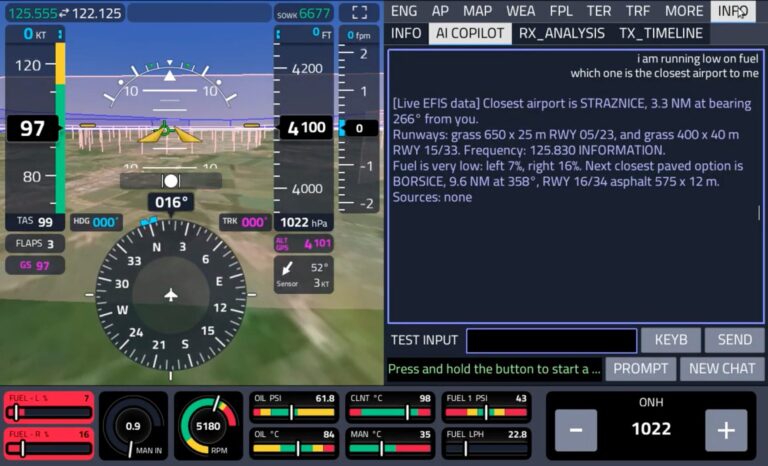
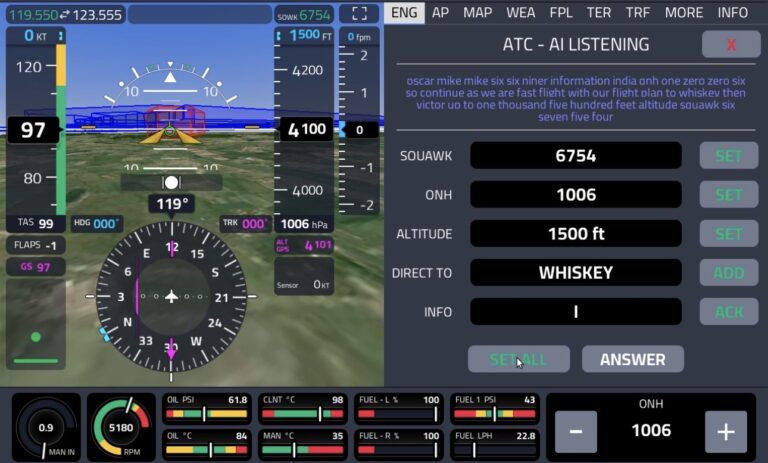
At Schochman, we are building a next-generation cockpit engine for 3D Airspace visualization. Instead of a flat map with colors and lines, pilots will see airspaces as volumes — textured, layered, and real. Our synthetic vision technology renders terrain, aircraft position, and airspaces in three dimensions, all in real time.
Why 3D Airspace Visualization Matters

Pilots fly in four dimensions: latitude, longitude, altitude, and time. Yet most EFIS (Electronic Flight Instrument Systems) and glass cockpits still treat airspace as a flat 2D overlay. The result? Height is reduced to bands or outlines, not immersive 3D Airspace.
Questions under workload:
- Am I above or below restricted airspace?
- Am I close to entering controlled airspace?
- How do I quickly judge vertical clearance?
Humans evolved to perceive depth and volume. Seeing airspace as 3D objects instead of 2D graphics is more natural — and safer.
Key Features of 3D Airspace Visualization
- Toggleable 2D / 3D mode for flexibility
- Volumetric airspaces with correct height and shape
- Color + transparency coding for clarity
- Embedded metadata such as frequencies and altitude limits
- Active / inactive states (coming soon) updated in real time
- Real-time aircraft rendering inside the 3D Airspace map
- Synthetic vision integration: volumes overlay terrain for intuitive navigation
During flight tests, seeing a TMA block ahead on the display — before noticing it outside — proved the effect works: pilots can “feel” 3D Airspace volumes they otherwise miss.
Technical Challenges in 3D Airspace Rendering
- Culling distant volumes: only relevant zones are drawn
- Complex polygons: simplified with level-of-detail
- Smooth coupling with aircraft position and zoom
- Embedded constraints: optimized GPU shaders and memory use
Safety Benefits of 3D Airspace
Preventing Spatial Disorientation
Spatial disorientation is a factor in 5–10% of aviation accidents (FAA Safety Briefing PDF). A natural 3D Airspace display helps pilots align instruments with mental awareness.
Reducing Navigation Errors
Historic accidents such as Varig Flight 254 and Adam Air Flight 574 show how misjudgments can escalate. Clearer 3D Airspace visualization lowers cognitive burden.
Avoiding Airspace Infringements
In 2023, the UK reported 1,231 infringements. A NASA/FAA study analyzed thousands of restricted-airspace violations worldwide. Many were caused by misjudging vertical limits. True 3D Airspace mapping can reduce these risks.
What’s Next for 3D Airspace at Schochman
- Dynamic activation / deactivation via live updates
- User customization for filters and transparency
- Performance tuning for complex geometries
- Pilot feedback from real flight testing
If you’re a pilot and want to test or see a demo, we’d love to talk. We believe 3D Airspace visualization is more than a gimmick — it’s a safer, more intuitive way to fly.
Learn More
- Read our work on Embedded Systems and AI avionics
- Explore Research & Development at Schochman
- Discover our Glass Cockpit Features
- Learn more about AHRS & Sensor Fusion
- Visit Schochman.com for news and updates